
Runtime Introduction
The Runtime is a high-performance execution environment designed specifically for minigames and lightweight apps. It is dedicated to delivering the ultimate experience of fast startup, stable operation, and no stuttering, providing near-native smooth performance even on low- to mid-end devices.
1. Runtime Core Architecture
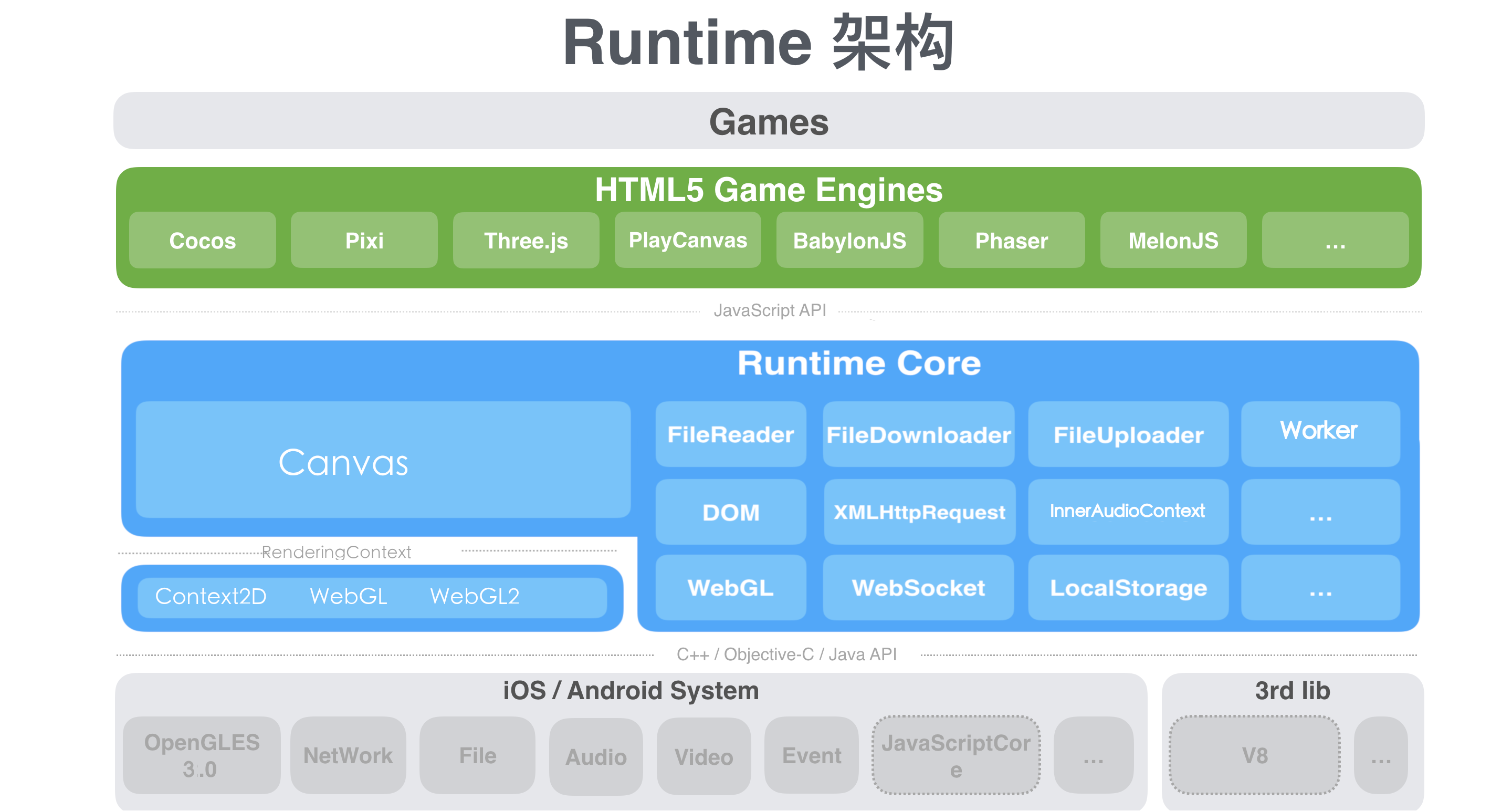
The Runtime adopts a lean and efficient kernel design that provides only the core capabilities required to run a game, ensuring maximum performance output.
2. Core Advantages
1. Cross-Platform Consistency
Supports multiple operating systems including Android, iOS, HarmonyOS, Windows, macOS, and Linux, ensuring highly consistent logic behavior and rendering results across different devices.
2. Deep Adaptation for Mainstream Engines
Provides full support for mainstream game engines such as Cocos, Unity, and LayaAir, offering standardized API interfaces so that minigames from other platforms can be easily ported, with excellent compatibility and ease of migration.
3. Multi-Threaded Independent Rendering
Unlike the single-render-thread architecture commonly used on the Web, the Runtime adopts a multi-threaded architecture with an independent render thread. The main thread and the render thread are separated and do not interfere with each other, greatly improving the smoothness of the game visuals.
4. Proprietary Package Format and Security
Supports encryption of game resources and code, effectively preventing decompilation and asset leakage. It uses a single-file format for packaging, significantly reducing disk IO overhead and dramatically accelerating the game loading process.
3. Deep Performance Optimization
1. WebAssembly (WASM) High-Performance Acceleration
For core complex modules such as physics collision, special-effect rendering, and animation parsing, the Runtime uses WASM. Executing at near-native binary speed, it is several times faster than ordinary JavaScript, thoroughly resolving computation bottlenecks in complex scenarios.
2. Intelligent Garbage Collection (GC) Mechanism
Adopts a layered GC management mechanism that manages the memory of script logic, the engine underlying layer, and the computation modules separately.
- Advantage: greatly reduces the "visual stutter" caused by traditional GC, effectively avoiding the "the longer you play, the laggier it gets" phenomenon that appears as the game runs over time, and ensuring stability during long-term operation.
3. Worker Multi-Threaded Asynchronous Computation
Supports Worker threads, allowing developers to offload time-consuming logic such as data processing and AI pathfinding to background threads.
- Effect: the main thread is dedicated to rendering the visuals, preventing computation tasks from taking over rendering time and ensuring the frame rate (FPS) stays consistently stable.
4. Full-Chain Underlying Optimization
Streamlined optimization has been applied across the full chain of rendering, memory, and resource loading:
Startup optimization: faster cold-start loading speed.
Memory optimization: lower static and dynamic memory usage, adapting to devices across all scenarios.